
Weather-Resistant Material Evaluation Testing UV Stability Against Manufacturer Warranties
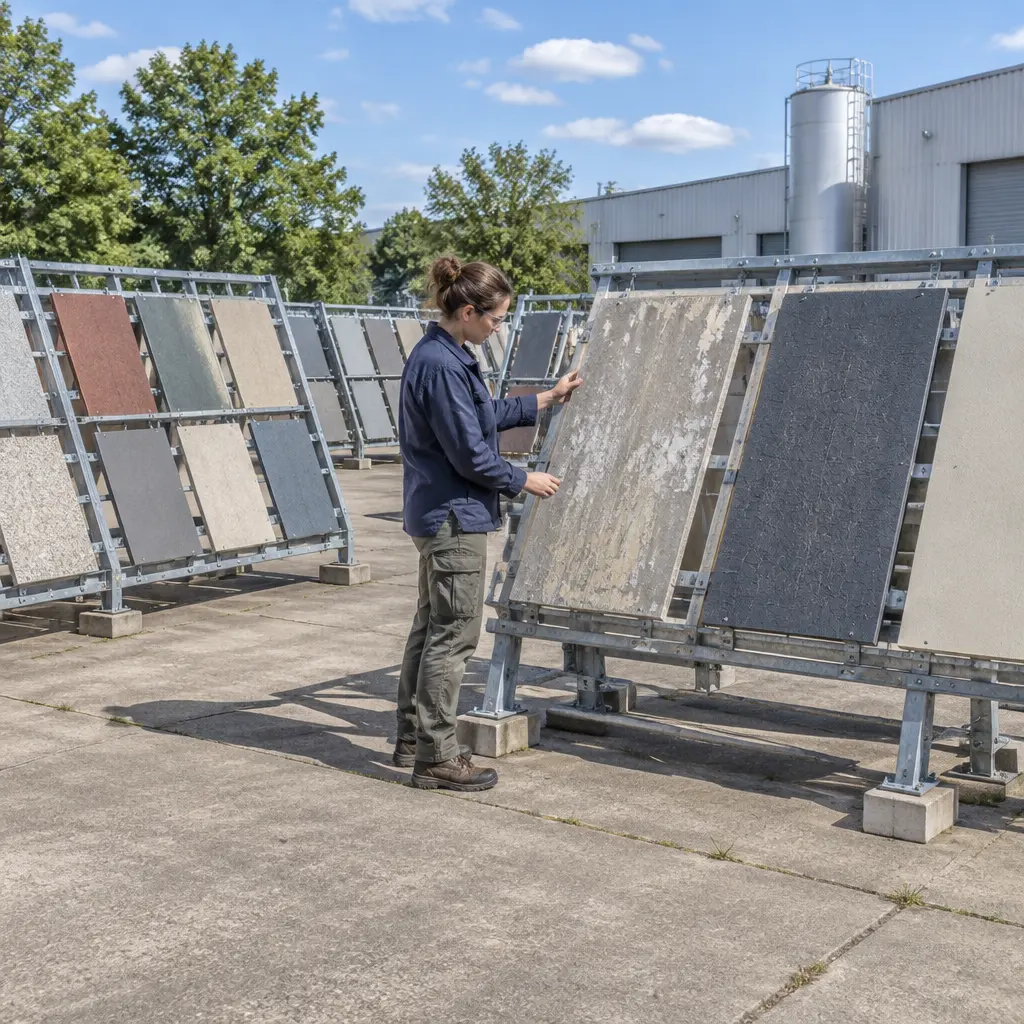
Weather-resistant material UV stability is the ability of a material to retain specified properties after exposure to ultraviolet radiation and related outdoor conditions. It is best evaluated through a documented test program that matches the intended use, distinguishes laboratory exposure from real-world service, and compares measured results with the exact warranty terms. That comparison matters because accelerated weathering results do not automatically establish a product’s service life or warranty eligibility: ASTM G154 and ISO 4892-3 specify controlled exposure methods, while manufacturers set their own product-specific limits, exclusions, and claim procedures.
UV Stability Defines Weather-Resistant Material Performance
“Weather-resistant” is a performance description, not a universal guarantee that a material will remain unchanged outdoors. UV stability focuses on resistance to sunlight-driven degradation, which can cause color change, chalking, cracking, embrittlement, loss of gloss, or reduced mechanical strength. The National Institute of Standards and Technology explains that outdoor polymer degradation depends on interacting factors such as radiation, temperature, moisture, oxygen, and material composition. Consequently, an effective evaluation specifies both the exposure conditions and the properties used to judge failure.
The distinction has practical and financial significance. A coating that retains color may still lose adhesion; a plastic that remains intact may become brittle. A warranty may cover one failure mode but exclude another, or require installation and maintenance conditions that laboratory testing does not address. The relevant question is therefore not simply whether a sample “passed UV testing,” but whether its tested performance, in the specified configuration, corresponds to the manufacturer’s written coverage.
Standardized Testing Measures Weather-Resistant Material UV Stability
ASTM International defines standardized test methods as controlled procedures for assessing material behavior under stated conditions. For UV weathering, ASTM G154 describes operating fluorescent ultraviolet lamp apparatus, while ISO 4892-3 specifies exposure methods using fluorescent UV lamps for plastics. These methods help laboratories report reproducible conditions, but neither standard by itself declares a product suitable for every climate or establishes a warranty duration.
Fluorescent UV and Condensation Exposure
Fluorescent UV testing exposes specimens to selected ultraviolet wavelengths and commonly alternates light exposure with condensation or water-related cycles. ASTM G154 covers key apparatus and operating variables, including lamp type, irradiance, temperature, and cycle design. Because different cycles create different stresses, a report should identify the specific cycle rather than state only that testing followed “ASTM G154.” Results are comparative evidence under the chosen conditions, not a direct conversion into years of outdoor life.
Xenon-Arc Weathering
Xenon-arc methods use filtered light intended to simulate aspects of the solar spectrum and may incorporate moisture exposure. ASTM G155 describes operation of xenon-arc light apparatus for exposure of nonmetallic materials. This approach can be useful when a product’s appearance or performance is sensitive to a broader range of solar wavelengths. As with fluorescent UV exposure, the chosen filters, irradiance, temperature, moisture cycle, and evaluation criteria must be reported to make results interpretable.
Outdoor Exposure and Service Conditions
Natural outdoor exposure tests place specimens at a specified site and orientation, where actual sunlight, rain, temperature, and pollutants act together. ASTM G7 provides practices for atmospheric environmental exposure testing of nonmetallic materials. Outdoor testing can improve relevance to a target environment, but it is slower and site-specific; performance in one location cannot automatically represent every climate. A sound program may combine accelerated laboratory tests with natural exposure and field inspection.
Measured Endpoints Connect UV Results to Product Performance
A test is meaningful only when it measures the properties that matter to the application and warranty. ASTM International’s weathering practices support controlled exposure, but the product specification must identify what counts as acceptable change. Testing should use representative specimens—including the same formulation, color, finish, thickness, and manufacturing process as the warranted product—because small differences can alter weathering behavior.
Color, Gloss, and Surface Appearance
Color change is commonly quantified instrumentally using color-difference measurements, while gloss is assessed with a glossmeter at a defined geometry. Visual inspection can also document chalking, fading, blistering, or surface cracking. These endpoints are especially relevant to architectural coatings, siding, signage, and exterior trim. A warranty may specify a maximum color change or restrict coverage to particular colors and exposure orientations, so the test report should use the same measurement approach and acceptance threshold wherever possible.
Mechanical and Functional Retention
Mechanical testing assesses whether exposure has weakened a material’s function. Depending on the product, endpoints can include tensile strength, elongation, impact resistance, flexibility, adhesion, or seal performance. For example, a polymer film that shows modest visual change may still fail if it cracks during bending, while a coating may retain color but lose adhesion to its substrate. Evaluating both appearance and function avoids treating cosmetic stability as proof of overall durability.
Exposure Dose, Replication, and Reporting
A defensible report records exposure duration and cycle, lamp and filter details, irradiance, specimen temperature, moisture conditions, sample preparation, number of replicates, and measurement procedures. It should also identify pre-exposure baselines and report variation among specimens. Reporting only “1,000 hours passed” is insufficient because elapsed chamber hours are not a universal measure of outdoor years. The U.S. Department of Energy’s materials-weathering guidance and standards organizations emphasize that exposure conditions and evaluation methods determine how results should be interpreted.
Warranty Terms Determine How UV Stability Is Judged
A manufacturer’s warranty is a contractual statement of coverage, not a general scientific conclusion about durability. Its meaning depends on the product, covered defect, duration, location, maintenance requirements, and exclusions. The Federal Trade Commission explains that written warranties for consumer products are governed by the Magnuson-Moss Warranty Act and related rules; the actual warranty document remains essential for determining the maker’s specific promises and claim conditions.
Coverage Scope and Exclusions
Warranty language may cover peeling, cracking, blistering, or excessive fading while excluding normal weathering, improper installation, unusual pollution, abrasion, or failure to maintain the product. Some warranties distinguish among product lines, colors, regions, and exposure orientations. Before testing, translate the warranty into measurable criteria: identify the covered failure mode, the threshold for a claim, and any required use or maintenance conditions. If the document promises color retention but not strength retention, those are separate questions.
Duration Is Not a Laboratory-Hour Conversion
A warranty period of a given number of years does not mean a fixed number of chamber hours proves equivalent performance. Accelerated weathering increases or controls stress to compare materials, but degradation mechanisms can change with spectrum, temperature, moisture, and material formulation. No universal conversion factor applies across products and climates. Manufacturers should substantiate any claimed correlation with field data and a clearly described test protocol rather than relying on a simple hours-to-years equation.
Evidence Needed for a Warranty Claim
Useful claim evidence includes dated photographs, purchase and installation records, product and batch identification, maintenance history, exposure location, and a description of the observed defect. Independent laboratory results can add weight when they identify the test standard, cycle, specimen provenance, and measured failure criteria. Consumers and specifiers should follow the warranty’s notification process and preserve samples where possible; a test performed on a different formulation or a nonrepresentative specimen may not resolve the claim.
A Practical Evaluation Compares Test Evidence with Warranty Language
The following workflow brings material science and contractual coverage together. It is suitable for procurement reviews, product qualification, and investigations of apparent premature deterioration.
- Obtain the current warranty, technical data sheet, and installation and maintenance instructions. Record the exact product, color, finish, and covered failure modes.
- Define the service environment, including expected sunlight, temperature, moisture, orientation, and relevant pollutants or coastal exposure.
- Select a recognized method—such as ASTM G154, ASTM G155, ISO 4892-3, or ASTM G7—based on material type and application. Specify the cycle and explain why it represents the intended use.
- Choose acceptance criteria tied to the warranty and function, including visual, color, gloss, mechanical, adhesion, or other product-specific endpoints.
- Test representative specimens with appropriate controls and replicates, and document baselines, exposure conditions, and measurement uncertainty.
- Compare results with the warranty wording without converting chamber time directly into service years. Investigate any mismatch through field data, manufacturer clarification, or additional testing.
A comparison matrix can make the decision transparent: list each warranty promise beside the matching test endpoint, method, acceptance threshold, and evidence gap. For example, a “no excessive fading” promise should be compared with a defined color-change criterion, while a “no cracking” promise requires inspection and, where appropriate, mechanical assessment. The matrix also helps identify promises that cannot be validated by the selected test.
Real-World Interpretation Requires Caution
The same material can weather differently across installations because exposure varies by latitude, shading, orientation, moisture retention, and surface temperature. A south-facing panel in a high-solar environment may experience a different stress profile from a shaded façade in a cooler region. Likewise, a coating applied at the wrong thickness or over an incompatible substrate may fail for reasons that UV testing of a correctly prepared laboratory coupon cannot reveal. These factors make field inspection and installation records important complements to chamber data.
For a real-world procurement example, consider an exterior polymer panel sold with a color-retention warranty. A laboratory report showing stable color after a specified xenon-arc cycle is relevant only if the tested panel matches the supplied formulation and the warranty’s color threshold is comparable to the report’s measurement. If the warranty also excludes installation defects, the evaluation must separately examine fastening, drainage, and substrate conditions. The test supports a focused technical comparison; it does not independently decide whether a contractual claim is valid.
Conclusion: Align UV Testing with Weather-Resistant Material Warranties
Weather-resistant material UV stability is best established through representative specimens, recognized exposure methods, application-relevant endpoints, and complete reporting. Fluorescent UV, xenon-arc, and outdoor exposure tests each provide useful but different evidence; none alone guarantees a specific outdoor lifespan. Warranty language adds a separate layer by defining covered defects, thresholds, exclusions, and claim procedures.
For buyers, manufacturers, and facility owners, the most reliable next step is to map every warranty promise to a test method and measurable criterion, then document any assumptions or gaps. Consult the applicable ASTM or ISO standard, request the full test report rather than a marketing summary, and review the written warranty before specifying or installing the material.
Sources: ASTM International, ASTM G154, Standard Practice for Operating Fluorescent Ultraviolet (UV) Lamp Apparatus for Exposure of Materials, https://www.astm.org/g0154.html; ASTM International, ASTM G155, Standard Practice for Operating Xenon Arc Lamp Apparatus for Exposure of Materials, https://www.astm.org/g0155.html; ASTM International, ASTM G7, Standard Practice for Atmospheric Environmental Exposure Testing of Nonmetallic Materials, https://www.astm.org/g0007.html; International Organization for Standardization, ISO 4892-3, Plastics—Methods of Exposure to Laboratory Light Sources—Part 3: Fluorescent UV Lamps, https://www.iso.org/standard/76094.html; National Institute of Standards and Technology, Polymer Degradation and Weathering research, https://www.nist.gov/; Federal Trade Commission, Businessperson’s Guide to Federal Warranty Law, https://www.ftc.gov/business-guidance/resources/businesspersons-guide-federal-warranty-law.
Related Post

What Designers Use for Beautiful Balcony Glow
Balcony Lighting: Designer Strategies for a Beautiful Glow. Balcony lighting is the deliberate selection and [...]
How to Choose Outdoor Furniture That Lasts
Outdoor furniture is furniture designed to remain usable in open-air settings, where sun, rain, temperature [...]
How to Build the Perfect Outdoor Furniture Collection
Outdoor furniture is a collection of seating, tables, and accessories designed to make patios, decks, [...]