
Task Lighting Beats Mood Lighting When You Know Where It Counts
Task lighting is focused illumination for a specific activity—such as reading, cooking, or working—while mood lighting primarily shapes a room’s atmosphere. When you put light where the work happens, task lighting can improve visibility and comfort more directly than relying on ambient glow alone. The U.S. Department of Energy recommends choosing lighting according to how a space is used, and the Illuminating Engineering Society’s recommendations vary by task rather than prescribing one brightness for every room. The practical approach is not to abandon mood lighting, but to build a useful layer of task light first, then add softer light around it.
Task lighting delivers focused illumination where activities happen
Task lighting is localized light intended to support a particular visual activity. The Illuminating Engineering Society (IES) develops recommended illuminance levels for different visual tasks; its guidance varies with the task, the user, and the conditions, rather than treating all rooms as needing the same amount of light. Illuminance is measured in lux, or lumens per square metre. A reading surface, kitchen counter, and workshop bench therefore call for different lighting strategies.
The main advantage is placement: a well-positioned lamp or under-cabinet fixture illuminates the work surface instead of making the whole room brighter. This can make details easier to see while avoiding unnecessary glare and spill. Task lighting is especially useful when room lighting is dim, when daylight is limited, or when an activity requires close visual attention. It is not a substitute for adequate general illumination; the two layers work best together.
Reading and desk lighting
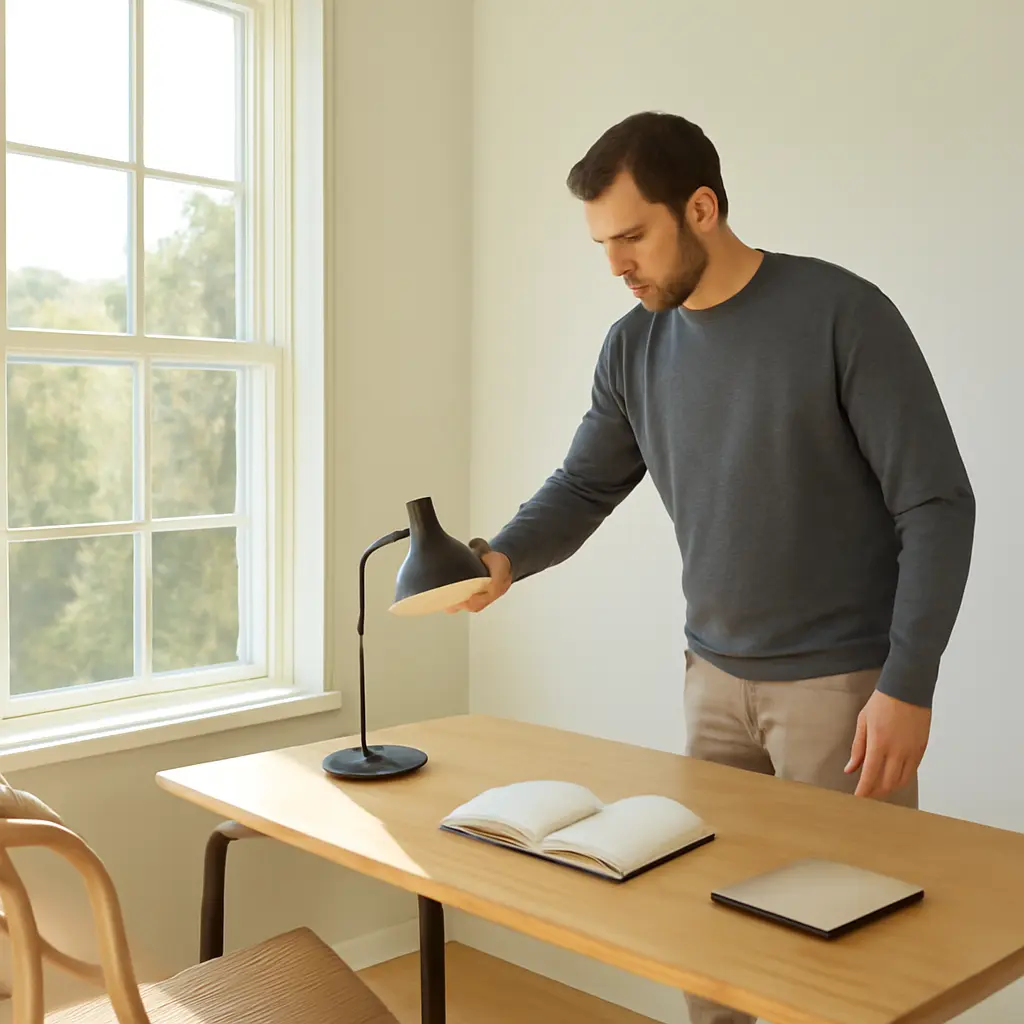
Reading and desk lighting directs light onto a book, keyboard, or paper without shining into the eyes or reflecting strongly from a screen. An adjustable desk lamp is useful because the beam can be moved as the task changes. Position it to reduce shadows from the writing hand, and keep the light source out of the direct line of sight. For computer work, combine a screen-friendly desk light with comfortable room lighting to reduce the contrast between a bright display and a dark background.
Kitchen and workshop lighting
Countertop, sink, sewing, and workshop lights make close-up work easier by bringing illumination to the surface where hands and tools operate. Under-cabinet kitchen fixtures are a common example: they can brighten counters that are shadowed by overhead cabinets or by the person working at the counter. In a workshop, adjustable task lights can help reveal small parts and surface details. In every case, choose fixtures with suitable diffusion and placement so that the beam does not cause glare or sharp shadows.
Because task needs differ from one surface to another, selecting a fixture is only half the job; the light’s colour and distribution matter too. That leads to a second practical question: how to make focused light comfortable rather than harsh.
Task-light quality depends on brightness, colour, and control
A useful task-lighting setup balances illuminance, colour rendering, beam direction, and user control. The U.S. Department of Energy explains that lumens describe the amount of light produced, while watts measure energy use. In other words, compare lamps by light output and quality, not by wattage alone. The right output depends on the size of the work area, surrounding light, fixture position, and the person using it.
Brightness and beam placement
Brightness at the task surface is more important than a lamp’s advertised lumen figure in isolation. A high-output bulb placed too far away may provide less useful illumination than a lower-output lamp positioned close to the work. Aim light so it reaches the task evenly, and avoid placing a bare bulb where it can be seen directly. Dimming is valuable when the same area is used for different activities or at different times of day.
Colour temperature and colour rendering
Correlated colour temperature, expressed in kelvins, describes whether light appears warmer or cooler; it does not indicate brightness. The Department of Energy notes that lower colour-temperature values look warmer and higher values look cooler. Colour rendering describes how faithfully a light source reveals object colours. For tasks involving food, clothing, art, or colour matching, a high colour-rendering index (CRI) can be helpful. Choose a colour appearance that feels comfortable and consistent with nearby lighting rather than assuming one temperature suits every task.
Glare, shadows, and visual comfort
Glare occurs when a bright source or reflection causes discomfort or makes details harder to see. It can come from an exposed bulb, a glossy countertop, or a lamp reflected in a monitor. Diffusers, adjustable shades, matte finishes, and careful positioning can limit the problem. The National Institute for Occupational Safety and Health (NIOSH) identifies lighting and glare as factors to consider in computer workstation ergonomics; practical adjustments include changing the light’s angle and reducing reflections on the display.
Once task light is comfortable and correctly positioned, mood lighting can add atmosphere without being asked to perform the work of a reading lamp or counter light. Separating those roles makes it easier to design a room that feels inviting and functions well.
Mood lighting complements task lighting rather than replacing it
Mood lighting is general or accent illumination chosen chiefly to influence the atmosphere of a space. It may include dimmed ceiling fixtures, wall sconces, decorative pendants, or indirect light reflected from walls. Unlike task lighting, it is not necessarily aimed at a work surface. The distinction is about purpose, not fixture type: one pendant can provide task light over a table, while a shaded lamp can create a softer ambient effect.
Layered lighting for adaptable rooms
Layered lighting combines ambient, task, and accent light so that a room can support several activities. For example, a living room might use a ceiling fixture for general visibility, a reading lamp beside a chair, and low-output accent lighting on a shelf. Separate switches or dimmers let people adjust each layer instead of choosing between a room that is uniformly bright and one that is too dim for practical use. The Department of Energy’s residential-lighting guidance similarly emphasizes selecting lighting for the intended application.
A practical home-office example
For a home office, begin with comfortable general illumination, then add an adjustable lamp for paper-based work. If using a monitor, position the lamp to avoid reflections and keep the display from becoming the only bright surface in an otherwise dark room. A dimmer or separate controls can support a shift from focused daytime work to a softer evening atmosphere. This is a practical application of ergonomic guidance, not a claim that one lighting arrangement guarantees better productivity or prevents eye strain.
Energy-conscious choices
LEDs make it easier to provide targeted light with lower energy use than older incandescent lamps. The U.S. Department of Energy states that residential LEDs use at least 75% less energy and last up to 25 times longer than incandescent lighting. A focused lamp can also avoid lighting unused parts of a room, though actual savings depend on the fixture, hours of use, and controls. Look for efficient products with suitable brightness, colour quality, and dimmer compatibility.
A simple method helps put task lighting where it counts
A room-by-room review is more reliable than choosing fixtures by appearance alone. Identify the activities, locate the surfaces where visual work happens, and then select and aim lights to suit those locations. Use mood lighting afterward to shape the room’s overall feel.
- List the main visual tasks in the room, such as reading, meal preparation, or computer work.
- Check for shadows, reflections, and areas where details are difficult to see.
- Choose a focused fixture with appropriate output, colour quality, and adjustability.
- Position and test the light from the normal working position, not just from across the room.
- Add ambient or accent lighting and use separate controls where practical.
The result is a lighting plan that serves people as well as the room’s appearance. Task lighting earns priority wherever visibility matters; mood lighting adds character once essential activities are comfortably supported. Review the lighting in your most-used spaces, adjust one task area at a time, and consult IES or Department of Energy guidance when choosing products for specialized work.
Sources: U.S. Department of Energy, Lighting Choices to Save You Money, https://www.energy.gov/energysaver/lighting-choices-save-you-money; U.S. Department of Energy, LED Lighting, https://www.energy.gov/energysaver/led-lighting; Illuminating Engineering Society, Recommended Practice: Lighting for Interior and Exterior Residential Environments, https://www.ies.org/standards/; National Institute for Occupational Safety and Health, Computer Workstations eTool, https://www.cdc.gov/niosh/docs/2004-131/; U.S. Department of Energy, Lighting Basics, https://www.energy.gov/energysaver/lighting-basics.